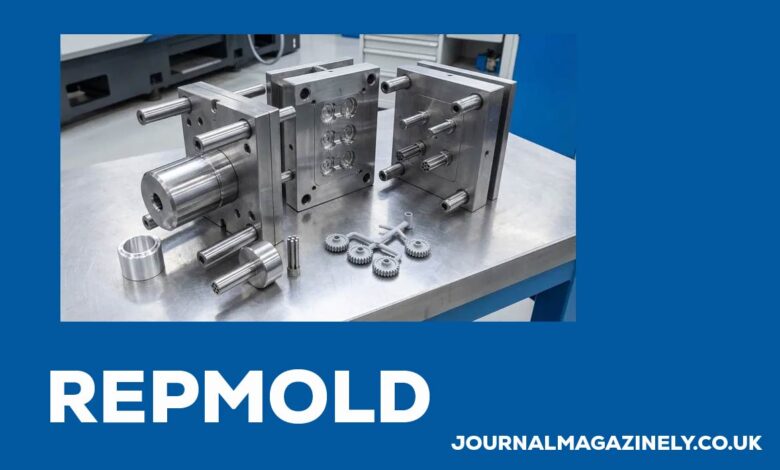
Manufacturing is changing quickly. Companies want to build products faster, improve accuracy, cut waste, and control costs. In this shift, the term Repmold is often used in online discussions about digital mold design, rapid tooling, prototyping, and precision production. It usually describes a modern workflow that combines design software, testing tools, and advanced fabrication methods to make mold development more efficient.
At the same time, Repmold is not a formal industry standard with one fixed definition. It is better understood as a broad term used for connected manufacturing methods that rely on CAD design, simulation, CNC machining, prototyping, and digital planning. That is why it should be explained clearly and carefully.
This article explores what Repmold usually means, how the process works, what technologies support it, where it is used, and why it matters in modern manufacturing.
What Repmold Usually Means
In simple terms, Repmold refers to a modern way of designing and producing molds with the help of digital tools. Engineers create a product or tool in software, test the design before fabrication, make early prototypes, and then move into mold creation with fewer mistakes and better control. This approach helps reduce delays and makes production planning more efficient.
A key idea behind Repmold is that design, testing, and manufacturing should work together instead of being handled as separate steps. When teams use one connected workflow, they can catch issues earlier and make faster decisions.
Because the term is used loosely online, it is best treated as a concept rather than a specific machine or patented system. The real value of Repmold comes from the manufacturing methods behind it.
Why Repmold Matters in Modern Manufacturing
Today’s manufacturers are under pressure to launch products faster without lowering quality. If development takes too long, a product may miss market demand or cost too much to produce. That is why Repmold matters. It reflects a practical approach to mold development that focuses on speed, better planning, and fewer late-stage changes.
In traditional mold work, problems sometimes appear only after machining or toolmaking has started. Fixing those issues can mean more material, more labor, and more lost time. A Repmold workflow tries to reduce that risk by solving more problems during the digital design stage.
This matters for both large factories and smaller production teams. Any company that wants better efficiency, more consistent quality, and a smoother path from idea to production can benefit from the principles linked to Repmold.
How the Repmold Workflow Begins
A Repmold workflow starts with product requirements. Engineers first define what the part must do, what material will be used, what tolerances are needed, and how many units are expected. These details shape every decision that follows, from design geometry to mold type.
Once those requirements are clear, the design team builds a 3D model in CAD software. This is not just a visual sketch. It includes exact dimensions, surface details, wall thickness, fit relationships, and other features needed for production. The digital model becomes the base for simulation, prototyping, and mold planning.
A strong start improves the whole process. When the design is well defined in the beginning, teams can work more confidently and avoid many of the mistakes that slow down production later.
The Role of CAD in Repmold
CAD is one of the most important parts of Repmold because it gives engineers a precise way to design and adjust parts before fabrication begins. A digital model can be changed quickly, reviewed in detail, and shared across teams. This makes the design stage faster and more accurate than manual methods.
In mold development, small design details matter a lot. Engineers must think about cavity shape, core structure, part release, wall thickness, and shrinkage. CAD helps them plan these features early so the mold performs better during production.
CAD also improves teamwork. Product designers, machinists, and quality teams can all work from the same file. That shared reference reduces confusion, speeds up communication, and lowers the chance of avoidable errors.
Simulation and Digital Validation
One of the biggest strengths of Repmold is the ability to test designs before physical mold work begins. Simulation tools help engineers study how a part or mold may behave during manufacturing. They can check material flow, heat movement, stress, and other factors that affect quality.
This does not replace physical testing, but it improves the starting point. Instead of moving forward with many unknowns, teams can begin with a design that has already been reviewed for common problems. That saves time and reduces the chance of expensive surprises.
Digital validation is especially useful because software changes are much easier than physical corrections. Fixing a model on-screen is usually faster and cheaper than changing a mold after machining has already started.
Rapid Prototyping in Repmold
Rapid prototyping is an important part of Repmold because it turns a digital design into something engineers can inspect and test. Early models may be made with resin printing, industrial 3D printing, CNC machining, or other quick fabrication methods. These prototypes help teams check whether a design works in real life.
The purpose of a prototype is not only to move fast. It is to learn early. A prototype can reveal fit problems, weak areas, surface issues, or design details that looked fine on-screen but need improvement in physical form.
This is why Repmold is useful in product development. It allows teams to test and improve designs without committing immediately to a full production mold, which lowers risk and supports better decision-making.
Mold Creation Methods Used in Repmold
After the design has been reviewed and prototypes have been tested, the next step is mold creation. The method depends on the material, production volume, surface finish, tolerance needs, and budget. Some projects need CNC-machined metal molds, while others may use silicone molds, prototype molds, or short-run tooling.
This flexibility is one of the practical strengths of Repmold. It is not tied to one mold-making method. Instead, it supports choosing the right tooling option for the project. A low-volume test run may need one type of mold, while a more demanding production part may need another.
By the time mold creation starts, the project has already gone through digital design, validation, and early testing. That usually means fewer unknowns and a clearer path toward reliable production.
Technologies That Support Repmold
Repmold depends on several technologies working together. The most common are CAD for design, CAM for machining preparation, CNC machines for precise fabrication, and additive manufacturing for prototyping or temporary tooling. Some workflows also include digital measurement tools, scanning systems, and inspection software.
Automation can improve the process by reducing repetitive manual work and helping maintain consistency. Connected data systems also support better tracking, which makes it easier to compare results across projects and improve future production.
Some discussions of Repmold also mention artificial intelligence. In practice, AI may help with analysis, defect detection, or planning in certain setups. But it should be treated as an added tool, not as the main definition of Repmold.
Main Benefits of Repmold
The biggest benefit of Repmold is speed. Because design, testing, and tooling are more connected, manufacturers can often move from concept to production more quickly. Faster iteration is valuable in competitive industries where timing matters.
Another benefit is precision. Digital modeling, controlled machining, and better validation support more accurate parts and more consistent results. This is especially important in industries where small errors can affect fit, safety, or performance.
Repmold also improves efficiency. Better planning helps reduce waste, lower redesign costs, and improve communication between teams. Instead of fixing repeated problems late in the process, manufacturers can make better decisions earlier.
Industries Where Repmold Is Useful
The ideas behind Repmold can be useful in many industries. In automotive manufacturing, they support prototype parts, brackets, housings, and other components that need accuracy and fast development. In aerospace and medical manufacturing, digital workflows help teams manage strict quality and tolerance demands.
Consumer electronics companies also benefit because they often need rapid design changes and shorter product cycles. Faster prototyping and smarter tooling make it easier to respond to market needs.
Industrial equipment makers, research teams, and product development groups can also use Repmold principles. Whether the goal is a custom part, a small production batch, or a test-stage mold, the process supports better planning and more reliable execution.
Repmold Compared With Traditional Mold Manufacturing
Traditional mold manufacturing still plays a major role in industry, especially for large production runs that need strong, durable tooling. In many cases, conventional methods remain the best choice. Repmold should not be seen as a full replacement for traditional mold making.
The main difference is in the workflow. Traditional processes may involve more manual handoffs and more physical correction after fabrication begins. Repmold puts more effort into digital preparation before those costly steps happen. That makes it especially useful for prototypes, revisions, and shorter production runs.
The best method depends on the job. Some projects need conventional tooling, while others benefit more from the speed, flexibility, and digital control that Repmold offers.
Challenges and Limitations of Repmold
Even with its advantages, Repmold is not always easy to adopt. Companies may need better software, more advanced equipment, and staff training. Without those basics, the process may not deliver the expected results.
It is also important to understand that not every project needs a fully digital workflow. Some high-volume or highly specialized jobs still rely on traditional tooling because it offers proven performance and strong long-term value.
There are also practical workflow challenges. Poor file management, weak communication, or inconsistent design standards can reduce the benefits of Repmold. The process works best when teams are organized, skilled, and willing to improve their systems over time.
Repmold and the Future of Smart Manufacturing
Repmold fits naturally into the move toward smarter manufacturing. Modern factories are using automation, connected machines, digital twins, smart sensors, and data-based planning to improve production. A digital mold workflow supports these same goals by making design and tooling more connected and easier to manage.
As manufacturing technology improves, Repmold workflows may become even more capable. Better simulation, stronger CNC systems, improved quality analytics, and smoother collaboration tools can make mold development faster and more reliable.
The long-term value of Repmold is practical. It helps manufacturers make better decisions, reduce waste, manage design changes, and improve consistency in a competitive market.
Conclusion
Repmold is best understood as a modern manufacturing concept built around digital design, testing, prototyping, and efficient mold development. While the term does not have one formal industry definition, it is widely used to describe workflows that connect CAD, simulation, rapid tooling, precision machining, and smarter production planning.
Its main value comes from faster development, better accuracy, improved teamwork, and fewer costly mistakes later in production. These benefits are especially useful in industries where quality and timing matter.
As manufacturing continues to evolve, the principles behind Repmold are likely to remain relevant. Companies that combine digital tools with solid engineering practice will be better prepared to build reliable products with greater speed and consistency.
For more information, visit Journal Magazinely